How BHASHINI Is Teaching AI to Speak 22 Indian Languages
How BHASHINI Is Teaching AI to Speak 22 Indian Languages
How BHASHINI Is Teaching AI to Speak 22 Indian Languages
India is home to one of the most linguistically diverse populations in the world. With 22 officially recognized languages and hundreds of dialects, communication has always been both a cultural strength and a technological challenge. Now, a government-backed initiative called BHASHINI is attempting to solve this at scale—by teaching artificial intelligence to understand and speak India’s many languages.
🌏 The Vision: AI Without Language Barriers
BHASHINI (Bhasha Interface for India) is part of India’s National Language Translation Mission, designed to make digital services accessible to every citizen—regardless of the language they speak.
The core idea is simple but powerful:
👉 No Indian should be excluded from digital access because of language.
Whether it’s accessing government schemes, healthcare information, or education platforms, BHASHINI aims to ensure everything is available in local languages.
🧠 How BHASHINI Works
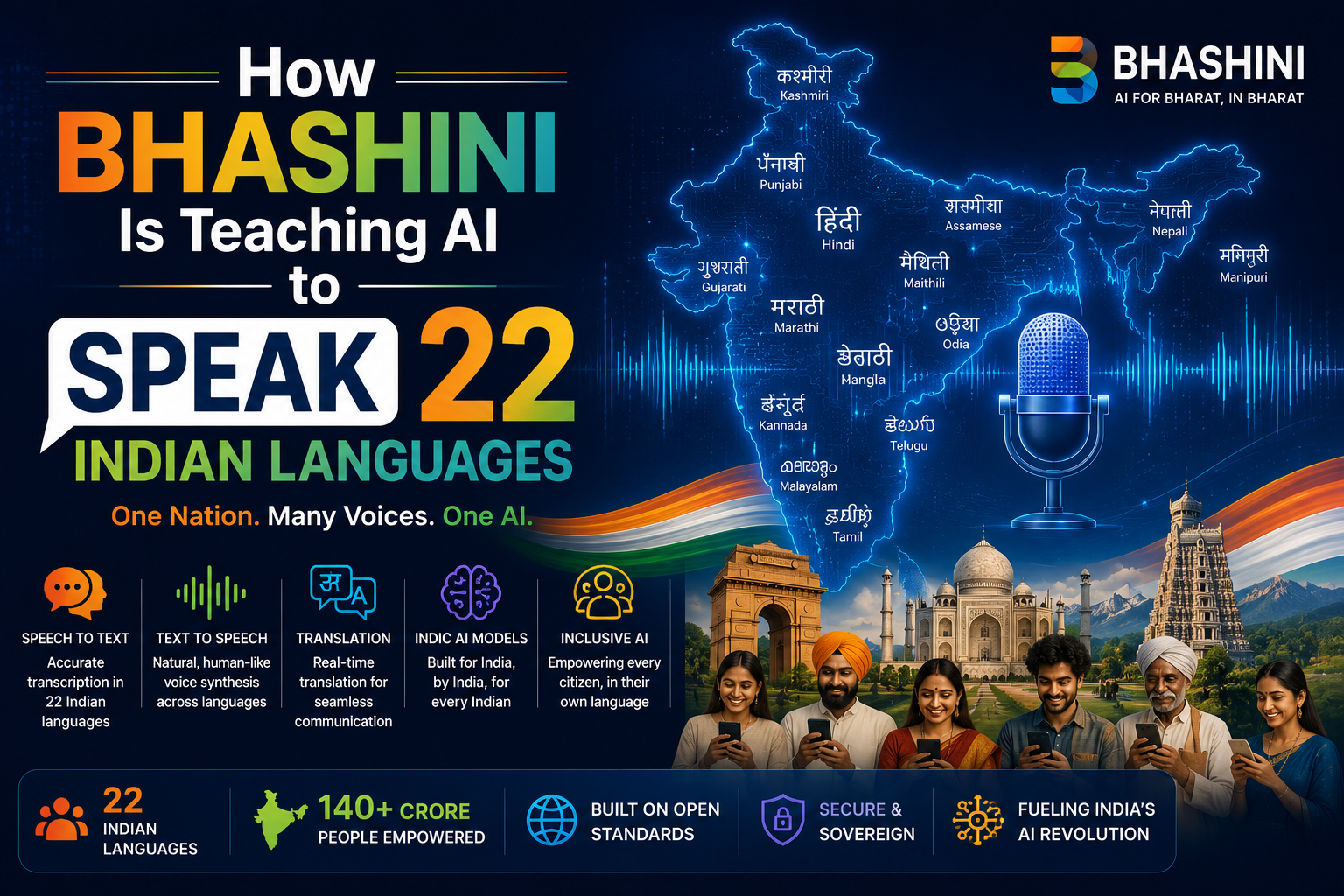
At its core, BHASHINI combines multiple AI technologies into one unified platform:
- Speech-to-Text (STT) – Converts spoken language into text
- Text-to-Speech (TTS) – Generates natural voice output
- Machine Translation – Translates between Indian languages
This enables real-time communication across languages—for example, a Hindi speaker talking to a Tamil speaker seamlessly through AI.
🇮🇳 Supporting 22 Indian Languages
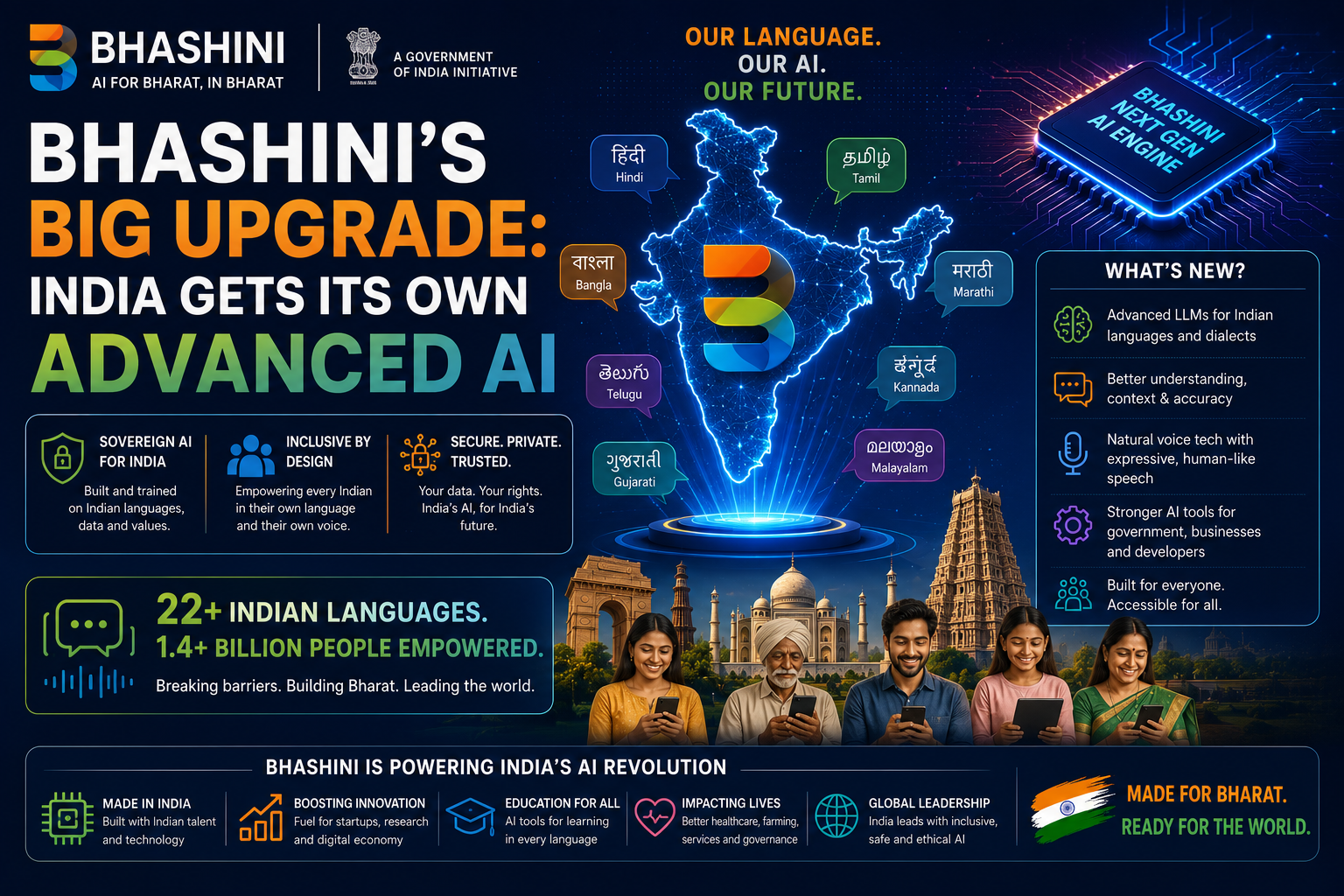
India’s Constitution recognizes 22 scheduled languages, and BHASHINI is built to support all of them.
What makes this challenging?
- Diverse scripts (Devanagari, Tamil, Telugu, etc.)
- Complex grammar structures
- Regional accents and dialects
- Code-mixing (e.g., Hinglish)
BHASHINI tackles this by building large multilingual datasets using open-source contributions and community participation.
🤝 Powered by Collaboration & Open Ecosystem
One of BHASHINI’s biggest strengths is its collaborative approach:
- Contributions from research institutions like IIIT Hyderabad
- Open datasets for developers and startups
- Integration with India’s growing AI ecosystem
This open model ensures continuous improvement and innovation, rather than relying on a closed system.
🚀 Real-World Impact
BHASHINI is already transforming multiple sectors:
🏛️ Governance
Government services can now be delivered in regional languages, improving citizen engagement and accessibility.
🎓 Education
Students can learn in their native language, reducing dependency on English-based resources.
🏥 Healthcare
Medical information becomes accessible to rural populations in their own language.
🚆 Public Services
Platforms like railways are integrating BHASHINI for multilingual user experiences.
🌐 Why BHASHINI Matters
The Times of India article highlights a crucial shift:
👉 Language is no longer just culture—it’s infrastructure.
BHASHINI is not just a translation tool; it’s part of India’s push toward:
- Digital inclusion at scale
- AI self-reliance (sovereign AI)
- Preservation of linguistic diversity
By enabling AI in Indian languages, the platform ensures that technology adapts to people—not the other way around.
⚖️ Challenges Ahead
While BHASHINI is ambitious, it still faces hurdles:
- Accuracy across dialects
- Handling informal and mixed-language conversations
- Scaling datasets for low-resource languages
But with continuous research and community involvement, these challenges are actively being addressed.
Tags
Share this article
Reviews & Ratings
Please login to submit a review for How BHASHINI Is Teaching AI to Speak 22 Indian Languages.
No reviews yet. Be the first to review How BHASHINI Is Teaching AI to Speak 22 Indian Languages!