Ai saravam
Pixxel and Sarvam: India’s First Orbital AI Data Centre is Pushing Computing Beyond Earth
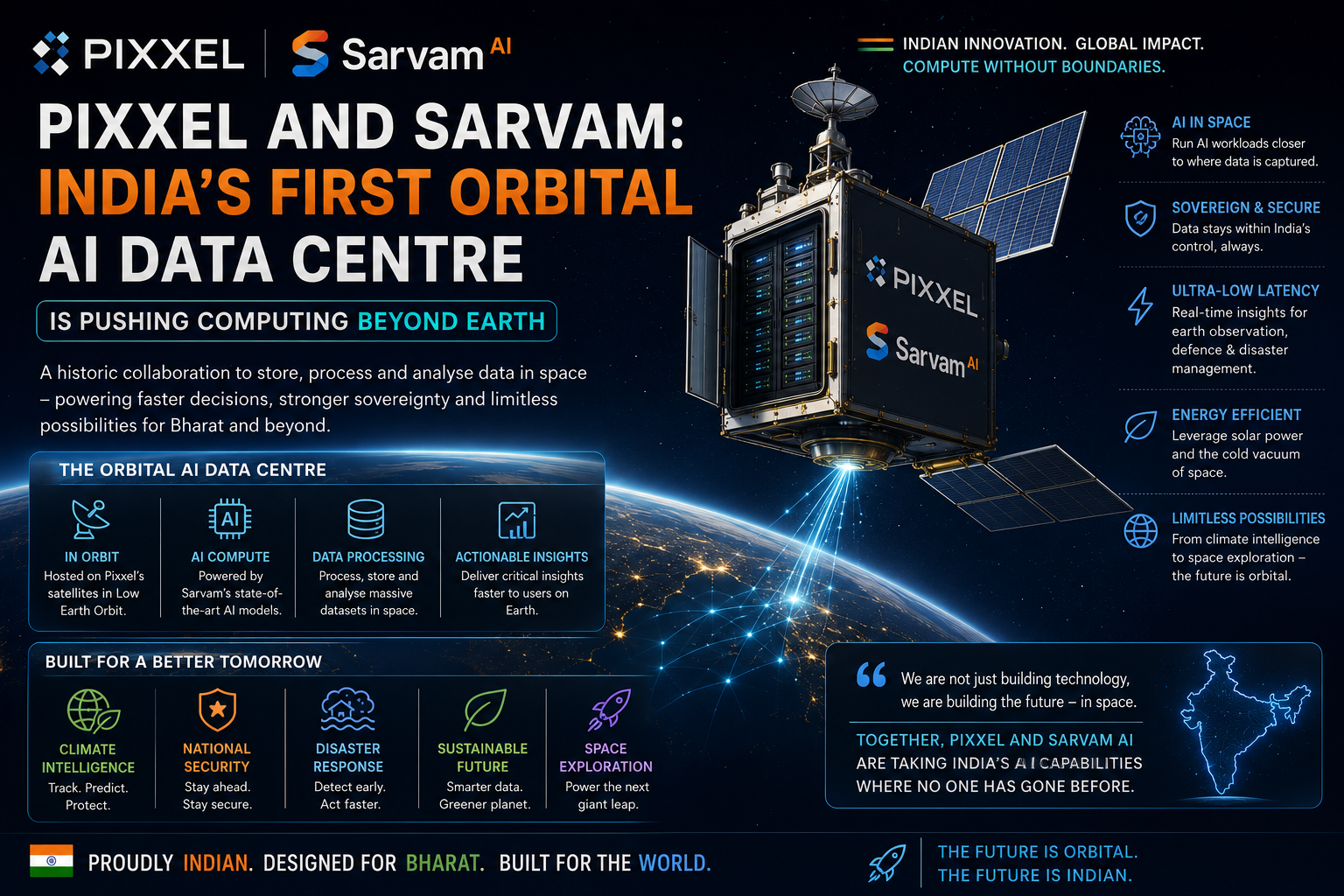
Pixxel and Sarvam: India’s First Orbital AI Data Centre is Pushing Computing Beyond Earth
Indian startups Pixxel and Sarvam AI have joined hands to launch India’s first orbital data centre satellite, called Pathfinder, in a path-breaking move which bridges space technology and artificial intelligence. This mission puts India at the forefront of space-based computing, where satellites can not only capture data, but also analyse and act on the data. Pixxel, Sarvam to launch India’s first orbital data centre satellite for AI training for blog content in details.
Here’s a detailed blog-style article about the launch of India’s first orbital data centre satellite by Pixxel and Sarvam:
India’s First Orbital AI Data Centre: Pixxel, Sarvam Go Beyond Earth For Computing. India’s first orbital data centre satellite, Pathfinder, is set to be launched by Indian startups Pixxel and Sarvam AI, marking a pioneering initiative that synergizes space technology with artificial intelligence. It makes India a leader in space-based computing, where satellites can not only collect data but also process and act on it while orbiting above the Earth.
The Next Level of Space-AI Integration
Bengaluru-based space technology company Pixxel, known for its hyperspectral imaging satellites, has joined hands with India’s sovereign AI platform developer Sarvam. The partnership will put datacentre-class GPU computing in space, enabling real-time AI data processing and inference in orbit.
Instead of sending raw data back to Earth for processing like traditional satellites, Pathfinder will process data onboard using Sarvam’s complete-stack AI models running on high-performance GPUs. This means faster insights, fewer delays in communication and greater efficiency on Earth observation tasks.
Key features of Pathfinder missions
High-performance orbital compute Pathfinder will host GPUs equivalent to those found in terrestrial data centres, enabling advanced AI training and inference in space.
Live Data Analytics: The satellite is equipped with Pixxel’s best-in-class hyperspectral imaging camera that enables the real-time acquisition and processing of high-fidelity imagery for near real-time monitoring of environmental shifts, resource use, and infrastructure trends.
Sovereign AI Architecture: Sarvam’s AI models, built in India and governed by India, are completely independent of foreign cloud infrastructure, further strengthening India’s technological sovereignty.
Sustainable Operation: Fueled by solar energy, these orbital data centers avoid the limitations of land, cooling and regulations, making them a greener alternative to traditional data centers.
The Visionaries Behind the Mission
Awais Ahmed, Pixxel’s CEO, emphasized that as traditional ground data centres face growing pressures related to energy use and scalability, orbital data centres offer a sustainable, scalable solution. “Compute can be powered by abundant solar energy and operate closer to space-based data,” he explained, highlighting how this innovation could define the future of space infrastructure.
Meanwhile, Pratyush Kumar, CEO of Sarvam, described the initiative as both a technological and sovereignty milestone. “AI infrastructure isn’t just about software — it’s about national control over intelligence systems. Now, with India-built models running in orbit aboard India-built satellites, our sovereignty extends into space,” he said.
Why Orbital Data Centres Matter
The Pathfinder mission represents more than a single satellite — it’s a testbed for the next generation of orbital computing systems. With global demand for AI computation skyrocketing, moving processing power closer to data sources — in this case, in orbit — is a logical next step.
This kind of setup is ideal for:
Environmental monitoring, where rapid analysis of climate and pollution data can inform policy decisions faster.
Resource management, including monitoring of water bodies, forests, and agricultural zones.
National security and infrastructure tracking, where real-time insights can support defense and disaster response operations.
Here’s a detailed blog-style article about the launch of India’s first orbital data centre satellite by Pixxel and Sarvam:
India’s First Orbital AI Data Centre: Pixxel, Sarvam Go Beyond Earth For Computing. India’s first orbital data centre satellite, Pathfinder, is set to be launched by Indian startups Pixxel and Sarvam AI, marking a pioneering initiative that synergizes space technology with artificial intelligence. It makes India a leader in space-based computing, where satellites can not only collect data but also process and act on it while orbiting above the Earth.
The Next Level of Space-AI Integration
Bengaluru-based space technology company Pixxel, known for its hyperspectral imaging satellites, has joined hands with India’s sovereign AI platform developer Sarvam. The partnership will put datacentre-class GPU computing in space, enabling real-time AI data processing and inference in orbit.
Instead of sending raw data back to Earth for processing like traditional satellites, Pathfinder will process data onboard using Sarvam’s complete-stack AI models running on high-performance GPUs. This means faster insights, fewer delays in communication and greater efficiency on Earth observation tasks.
Key features of Pathfinder missions
High-performance orbital compute Pathfinder will host GPUs equivalent to those found in terrestrial data centres, enabling advanced AI training and inference in space.
Live Data Analytics: The satellite is equipped with Pixxel’s best-in-class hyperspectral imaging camera that enables the real-time acquisition and processing of high-fidelity imagery for near real-time monitoring of environmental shifts, resource use, and infrastructure trends.
Sovereign AI Architecture: Sarvam’s AI models, built in India and governed by India, are completely independent of foreign cloud infrastructure, further strengthening India’s technological sovereignty.
Sustainable Operation: Fueled by solar energy, these orbital data centers avoid the limitations of land, cooling and regulations, making them a greener alternative to traditional data centers.
The Visionaries Behind the Mission
Awais Ahmed, Pixxel’s CEO, emphasized that as traditional ground data centres face growing pressures related to energy use and scalability, orbital data centres offer a sustainable, scalable solution. “Compute can be powered by abundant solar energy and operate closer to space-based data,” he explained, highlighting how this innovation could define the future of space infrastructure.
Meanwhile, Pratyush Kumar, CEO of Sarvam, described the initiative as both a technological and sovereignty milestone. “AI infrastructure isn’t just about software — it’s about national control over intelligence systems. Now, with India-built models running in orbit aboard India-built satellites, our sovereignty extends into space,” he said.
Why Orbital Data Centres Matter
The Pathfinder mission represents more than a single satellite — it’s a testbed for the next generation of orbital computing systems. With global demand for AI computation skyrocketing, moving processing power closer to data sources — in this case, in orbit — is a logical next step.
This kind of setup is ideal for:
Environmental monitoring, where rapid analysis of climate and pollution data can inform policy decisions faster.
Resource management, including monitoring of water bodies, forests, and agricultural zones.
National security and infrastructure tracking, where real-time insights can support defense and disaster response operations.
Tags
Share this article
Reviews & Ratings
Please login to submit a review for Pixxel and Sarvam: India’s First Orbital AI Data Centre is Pushing Computing Beyond Earth.
No reviews yet. Be the first to review Pixxel and Sarvam: India’s First Orbital AI Data Centre is Pushing Computing Beyond Earth!