Bhashini vs Sarvam vs ChatGPT—India's AI future is actually a team game.
Bhashini vs Sarvam vs ChatGPT—India's AI future is actually a team game.
Roads, Desi Engines, and Supercars: How India’s AI Stack Actually Works
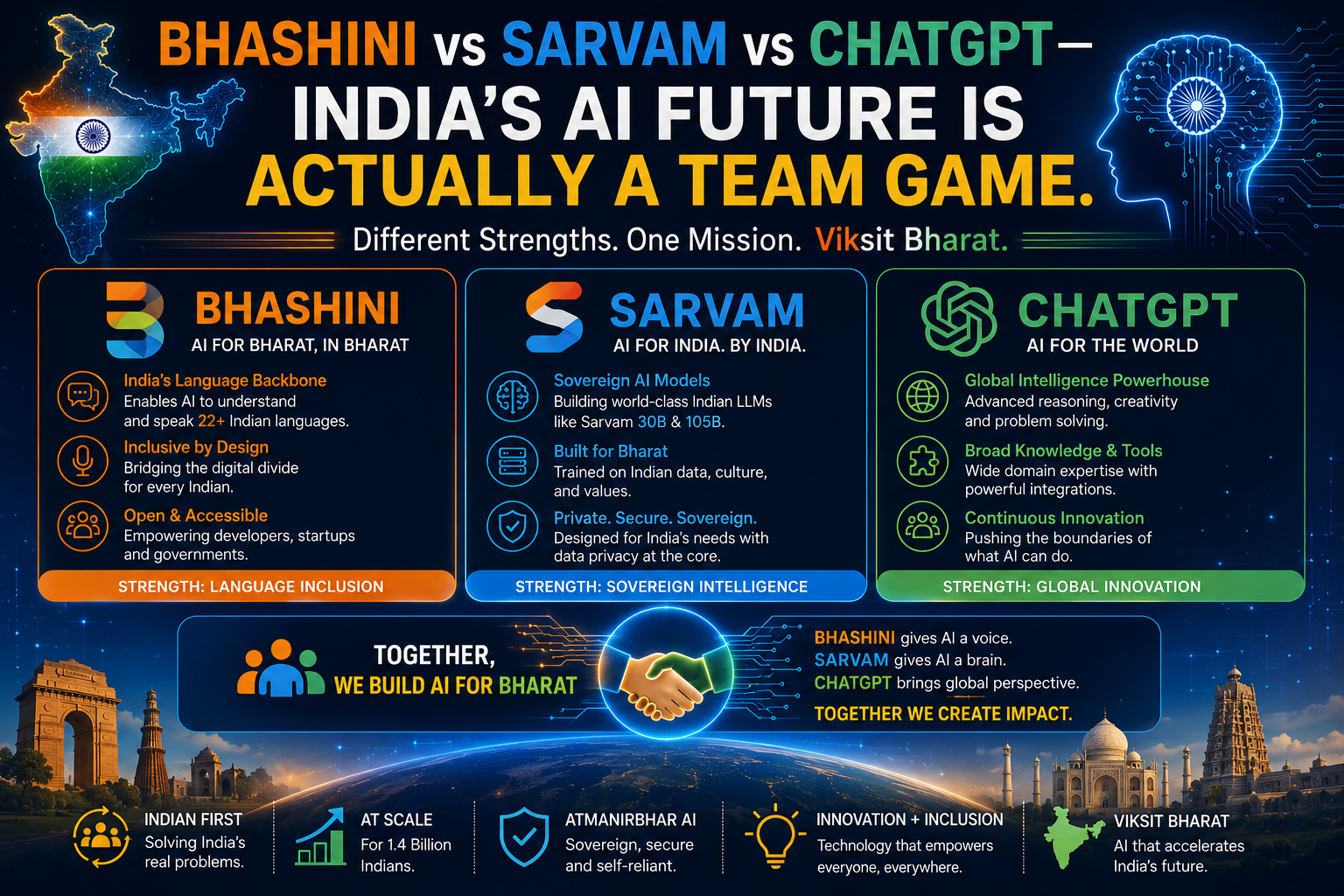
India’s AI scene is getting really interesting right now. Instead of just relying on big global giants like OpenAI or Google, we are quietly building our own AI stack. We've got BHASHINI handling the infrastructure and Sarvam AI building the models.
But here’s the thing most people get wrong: Bhashini, Sarvam, and Global AIs aren't really fighting each other. They actually operate on totally different layers of the same game.
Let’s break this down simply.
Meet the Three Players
🇮🇳 BHASHINI (The AI Highway) Think of Bhashini as the public infrastructure, just like UPI is for payments. It’s a government-backed platform that provides the APIs for speech-to-text, translation, and text-to-speech. It doesn't "think" on its own; it integrates various AI models (including Sarvam) and acts as the delivery guy. It’s the highway.
🇮🇳 Sarvam AI (The Desi Engine) If Bhashini is the highway, Sarvam is the car driving on it. Sarvam is a private startup that builds Large Language Models (LLMs) from scratch. They train their models deeply on Indian languages, local datasets, and our cultural context. In fact, for specific Indian-language tasks, Sarvam actually beats the global giants.
🌍 Global AI (The Imported Supercars) These are your ChatGPTs, Gemini, and Claude. They are massive, full-stack AI ecosystems. They are brilliant at complex reasoning, coding, and multimodal tasks (handling images, video, and text). But at their core, they are built for a global, English-first audience.
The Quick Breakdown
- What is it? Bhashini = Infrastructure | Sarvam = Models | Global AI = Full platforms
- Who owns it? Bhashini = Govt of India | Sarvam = Indian Startup | Global AI = Foreign Tech Giants
- Language Focus: Bhashini = Access for all | Sarvam = Indian-first | Global AI = English-first
- Open or Closed? Bhashini & Sarvam = Open ecosystem | Global AI = Mostly closed/proprietary
The Language Game: Why Local Wins
Global AIs speak English beautifully. But ask them to understand a thick rural dialect or a Hinglish conversation, and they often fumble.
That’s where Bhashini and Sarvam shine. Bhashini is built specifically to handle dozens of Indian languages and dialects so the everyday citizen can use digital services. Sarvam trains on our local data, so it naturally gets our code-mixing and regional context. For India-specific tasks, the homegrown guys have the edge.
Brainpower vs. Budget
Let’s be real—Global AIs are still the smartest kids in the room for complex logic and creative tasks. But using them at a massive scale in India is super expensive, especially for local language processing.
Sarvam gives you competitive performance at a much lower cost for Indian workloads. And Bhashini? It’s basically free public infrastructure. If you are an Indian startup or a government agency, combining Bhashini + Sarvam is the ultimate money-saving hack.
Why India is Building Its Own Stack
For years, we just used whatever the global tech companies built. But now, data sovereignty is a big deal. We need our data to stay within India, we need to follow our own local regulations, and we need AI that actually understands our culture. We are shifting from reliance to self-reliance.
Teamwork Makes the Dream Work
This is the most important part: this isn't a fight to the death. The future of AI in India is a hybrid stack.
Imagine an app where a farmer speaks in Marathi...
- Bhashini catches his voice and converts it to text.
- Sarvam processes the query locally, understanding the agricultural context cheaply and quickly.
- If the query needs complex legal reasoning, it calls OpenAI for the heavy lifting.
The Bottom Line
Think of it like transportation in India:
- Bhashini is the road network (the infrastructure).
- Sarvam is the Maruti or Tata car (built for Indian roads, cost-effective).
- Global AI is the imported Ferrari (powerful, but expensive and not for everyone).
The future isn't "Bhashini vs Sarvam vs OpenAI." It’s Bhashini + Sarvam + Global AI, all working together.
Tags
Share this article
Reviews & Ratings
Please login to submit a review for Bhashini vs Sarvam vs ChatGPT—India's AI future is actually a team game..
No reviews yet. Be the first to review Bhashini vs Sarvam vs ChatGPT—India's AI future is actually a team game.!